
What Google AI Overviews mean for brands in 2026, and why authority has become the key to SEO success.
There is a curious paradox occurring in the world of search right now: your brand can be both everywhere and nowhere at the same time.
In the past, the approach was straightforward: create content, achieve rankings, and attract clicks. This would lead traffic to your site, generate leads, and establish your website as the central hub for building relationships. It worked because the logic was simple: visibility equated to opportunity.
However, that equation is beginning to break down.
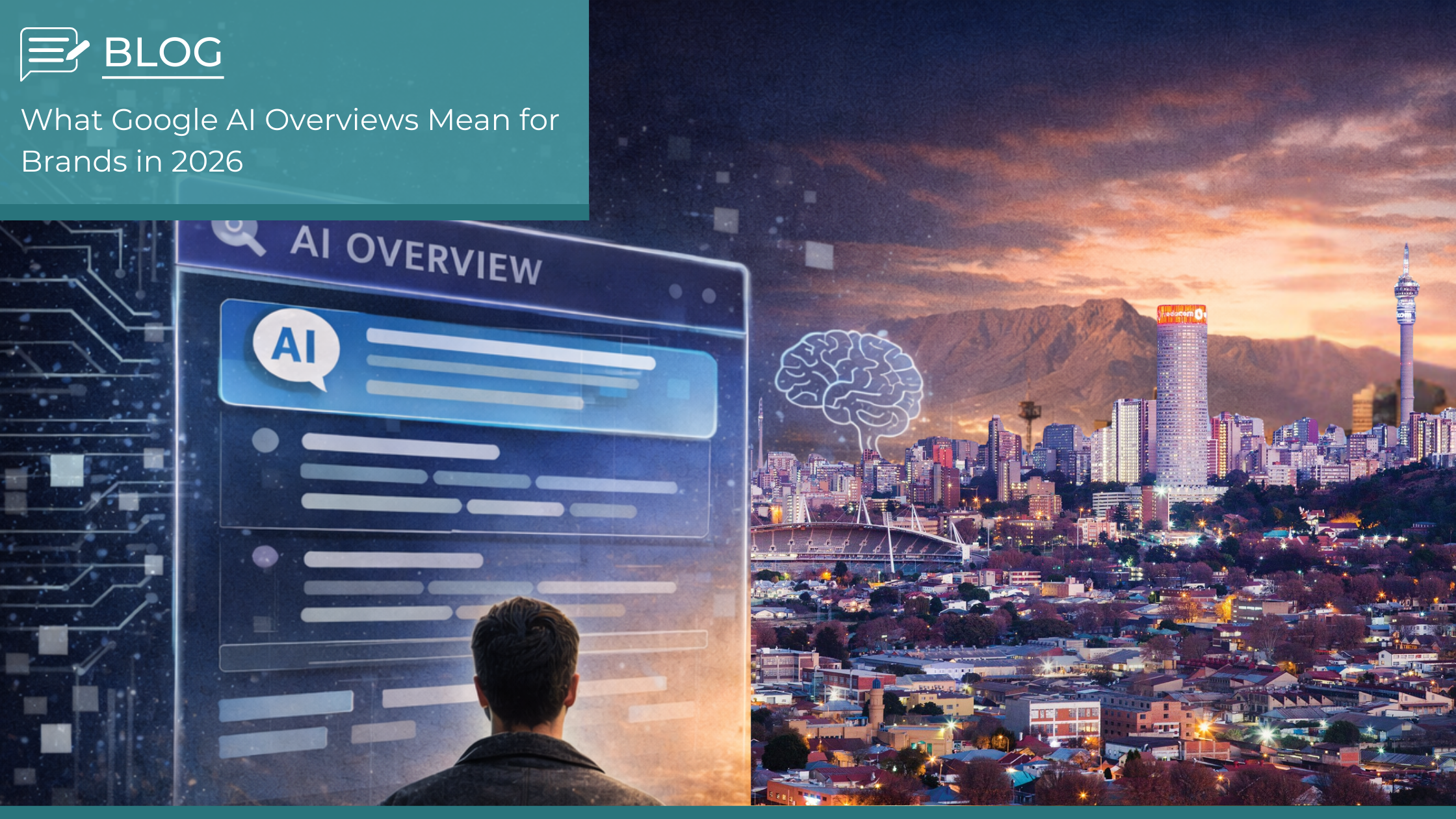
Google increasingly provides direct answers to questions right within the search results. Its AI Overviews compile information from multiple sources and present it as a concise summary, with traditional links taking on a more supportive role. The company claims that these features are now functioning on a global scale, and the resulting behavioural shift is already measurable. In March 2025, the Pew Research Centre examined what happens when AI summaries appear in search results. The findings were stark: users clicked through to a traditional result in just 8% of visits when an AI Overview was present, compared to 15% when it wasn’t. That’s nearly half the click-through rate, wiped out by a feature most users barely notice.
This creates an uncomfortable new reality for brands. You can win visibility without winning the visitor. You can rank without the reward. And if your business still measures success primarily through website traffic, you might be celebrating metrics that no longer correlate with commercial outcomes.
The trust problem nobody wants to discuss
Search is becoming a place where brands are assessed, filtered, and either believed or dismissed before anyone lands on a website. It’s the first impression you never get to control, delivered by an interface that wasn’t designed to care about your nuance.
So the question becomes urgent: if your audience isn’t visiting your site as often, how do you still build trust, establish authority, and convert interest into revenue?
The answer isn’t to manufacture more content or chase algorithmic loopholes. The answer is to become the kind of source that AI systems, and more importantly people, want to reference in the first place.
Why “SEO” is being rewritten in real time
The rollout of AI Overviews has been anything but smooth. Throughout 2025, search industry analysts tracked significant volatility. Semrush reported that AI Overviews initially expanded beyond informational queries into commercially relevant spaces, then contracted, then expanded again. The pattern suggests experimentation at scale, with Google still figuring out where these features belong.
That volatility matters because it tells you something important: this isn’t a temporary feature you can afford to ignore. It’s a directional shift in how search works.
Google now provides explicit guidance for site owners on how content may appear within AI-powered features, acknowledging that the relationship between creators and the search interface is fundamentally changing. At the same time, the quality stakes have never been higher. Recent reporting from The Guardian highlighted cases where AI summaries provided misleading health information, raising serious concerns about accuracy and user harm.
Even if your business operates outside health or finance, the principle holds. In a world where AI mediates between your expertise and your audience, trust becomes the product. And trust cannot be gamed into existence through keyword density or technical tricks.
When traffic declines, what replaces it?
This is where panic sets in for most brands, and panic produces terrible strategy. Usually in the form of content farms, AI-generated filler, or desperate pivots to platforms that promise easy reach.
The smarter approach is to accept that the goal itself is changing. Instead of measuring success purely by sessions and pageviews, you start tracking three new outcomes:
1) Share of answer
Are you the source being referenced, summarised, and relied upon when AI systems pull information together? This isn’t vanity. It’s brand positioning at the exact moment when decisions get made.
2) Share of trust
Do you look credible before anyone speaks to you? Does your site, your content, your authorship, and your digital footprint feel like it belongs to a legitimate organisation with genuine expertise?
Google’s Search Quality Rater Guidelines (the internal document used to train human evaluators) are unusually explicit about what quality looks like. Raters are instructed to assess Experience, Expertise, Authoritativeness, and Trust, and to look for clarity about who is responsible for the website and its content. These aren’t abstract ideals. They’re operational standards.
3) Share of demand
If fewer people click for generic queries, branded search becomes the differentiator. Brands that people actively search for by name, or with high-intent commercial language, are far less vulnerable to a world of instant summaries.
This is where premium marketing returns to its roots: not volume, not hacks, but reputation, proof, and a clear point of view.
E-E-A-T is no longer optional
Google’s guidance on creating “helpful, reliable, people-first content” explicitly directs creators back to the E-E-A-T framework. That’s not a casual suggestion. It’s a signal that the internet is entering a credibility audit, and the brands that survive will be those that can demonstrate all four pillars convincingly.
When AI is the intermediary between you and your audience, your content has to do more than rank. It has to hold up under scrutiny.
Here’s what that looks like in practice:
Experience: You can’t outsource lived experience to generic copy. The internet is already drowning in content that sounds plausible but has never been tested, used, or lived. The antidote is evidence of real practice. Case examples, observations from actual work, specific lessons learned, and honest disclaimers about what you have and haven’t done.
Expertise: Expertise shows up in how you explain, not what you claim. It’s the difference between “here are trends” and “here’s what changes operationally, what it costs, and what to do first.” One is commentary. The other is counsel.
Authority: Authority isn’t a badge you award yourself. It’s consensus. Do credible sources reference you? Do others align with your claims? Do you show your workings, or just your conclusions?
Trust: Trust is what remains when users arrive sceptical. It’s transparency, provenance, and consistency across your site, your people, and your broader footprint.
Why premium brands will win in the AI era
At Republic Digital Consultancy, we see this shift as a filter. The brands that survive won’t be the loudest. They’ll be the most believable.
Here’s the principle we’re building around for 2026: In the AI era, content is no longer written simply to attract clicks. It’s written to earn belief. The brands that win will be those that can be verified, not just discovered.
That’s the real strategic pivot. You’re not just competing for attention any more. You’re competing for credibility in an environment where attention is abundant and belief is scarce.
A practical playbook for 2026
Most strategy blogs stop at diagnosis. But diagnosis without direction is just anxiety with footnotes. Here’s what changes outcomes:
Build citation-ready pages. AI summaries reward clarity and structure. Create cornerstone content that is tightly organised, explicit about definitions, backed by reputable references, and updated regularly with visible versioning. Make it easy for both systems and humans to trust what you’re saying.
Show your authors, not just your logo. If your site reads like it was written by nobody, it will be trusted by fewer people. Add author names and bios. Include credentials and real-world experience. Publish editorial standards. Make it clear who’s responsible for the content. Google’s own guidelines stress knowing who stands behind the information.
Replace content volume with editorial discipline. The internet doesn’t need more noise. It needs fewer, better assets. One strong pillar page beats five thin blogs. One credible case study beats ten generic listicles. One thought piece with evidence beats a month of recycled trends.
Track outcomes beyond clicks. If AI is changing click behaviour, your reporting must change too. Track brand search growth, lead quality and conversion rates, assisted conversions, share of voice on high-intent queries, backlinks, and quality mentions. Pew’s research makes it clear that click behaviour shifts when AI summaries appear. You can’t manage what you refuse to measure.
Treat trust as a conversion asset. This includes transparent policies, proof-driven messaging, clean user experience, credible FAQs that reduce uncertainty, and plain-language service pages that explain your approach the way a real firm would. Trust isn’t a nice-to-have. It’s infrastructure.
The question that deserves our attention.
A decade ago, the marketing question was: “How do we get found?”
In 2026, the question becomes: “When we are found, are we believed?”
Discovery is becoming cheaper. Trust is becoming rarer. And for premium brands, rare is the point.
Want RDC to help you build authority that holds in 2026?
If you’d like a structured assessment of your current visibility, content credibility, and search readiness for AI-powered features, Republic Digital Consultancy can run an Authority and Trust Audit and provide a prioritised roadmap built for measurable outcomes.